
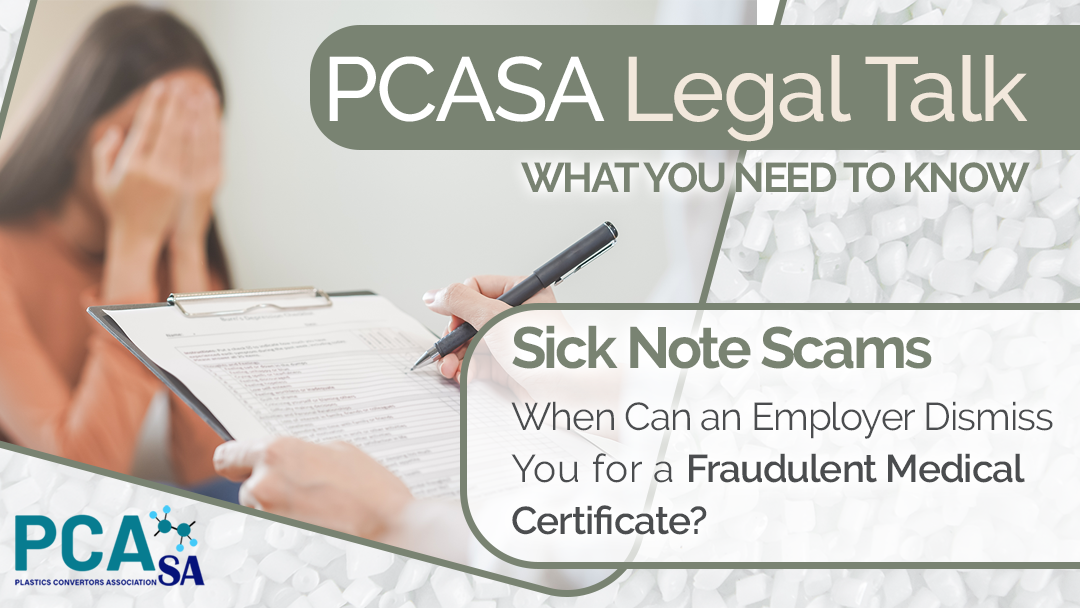
The Core Principle in South African Labour Law
In South African labour law, taking time off work due to illness requires a medical certificate. However, the submission of a suspicious or fraudulent medical certificate or sick note scams does not automatically warrant dismissal.
The employer’s right to dismiss an employee hinges on one critical factor: Did the employee knowingly participate in the fraud?
This principle was clearly affirmed in a landmark 2024 judgment by the Labour Appeal Court (LAC) in the case of Woolworths (Pty) Ltd v CCMA and Others.
Key Takeaways from the Woolworths v Maseko Judgment
The LAC clarified the high burden of proof employers face when seeking to dismiss an employee over an irregular sick note. Here are the essential findings:
- Irregularity Alone is Not Proof of Employee Dishonesty
The simple fact that a medical certificate is later found to be irregular, incomplete, or issued by a questionable doctor does not automatically mean the employee committed misconduct. The court affirmed that submitting an irregular document is not proof of employee dishonesty.
- Proof of Employee Knowledge is Essential
For dismissal to be justifiable, the employer must prove, on a balance of probabilities, that the employee knew or was actively involved in the deception. Proof of this knowing involvement could include evidence that the employee:
- Was not actually ill but successfully misled the doctor to get the certificate.
- Altered or forged the certificate themselves after receiving it.
- Knew the healthcare provider was unregistered, unqualified, or operating fraudulently.
- Employer Suspicions about the Doctor Are Irrelevant
An employee who genuinely believed they were ill and received a certificate from a doctor who appeared to be qualified and registered cannot be held accountable for any subsequent suspicions or findings about the doctor’s questionable practice.
The LAC stressed that the employee cannot be punished for the doctor’s misconduct.
- The Responsibility to Verify Credentials Rests with Regulators
The court ruled that ordinary employees cannot reasonably be expected to investigate a medical practitioner’s credentials, registration status, or professional practices – that is the explicit job of regulatory bodies like the Health Professions Council of South Africa (HPCSA).
- Substantive Fairness Requires Direct Evidence
The LAC heavily emphasised the employer’s burden to ensure both procedural and substantive fairness. For a dismissal to be fair, the employer must have direct, credible evidence of the employee’s misconduct – not merely circumstantial evidence or speculation based on hearsay or suspicion about the doctor.
Bottom Line for Employers and Employees
- For Employees: If you genuinely felt ill and obtained a certificate from a doctor you believed was legitimate, you are protected.
- For Employers: Be cautious. Without direct proof that the employee knew or intended to defraud the company by using a faulty sick note, the dismissal will likely be deemed substantively unfair. You cannot pass the burden of investigating the medical profession onto your staff.
Dismissal in these cases requires proof of employee knowledge or intent, not just proof of a flawed document.
PCASA exclusively represents members in the Plastic Industry and provides updated, in-depth training in labour relations ensuring your business is heard and protected on key policy and regulatory matters. Contact us today!
Natalie: +27 72 968 7808 – natalie@pcasa.co.za
Gretchén: +27 82 830 7281 – gretchen@pcasa.co.za
Nadine: +27 82 308 5337 – nadine@pcasa.co.za
admin@pcasa.co.za
* PCASA exclusively represents members in the Plastic Industry. *