
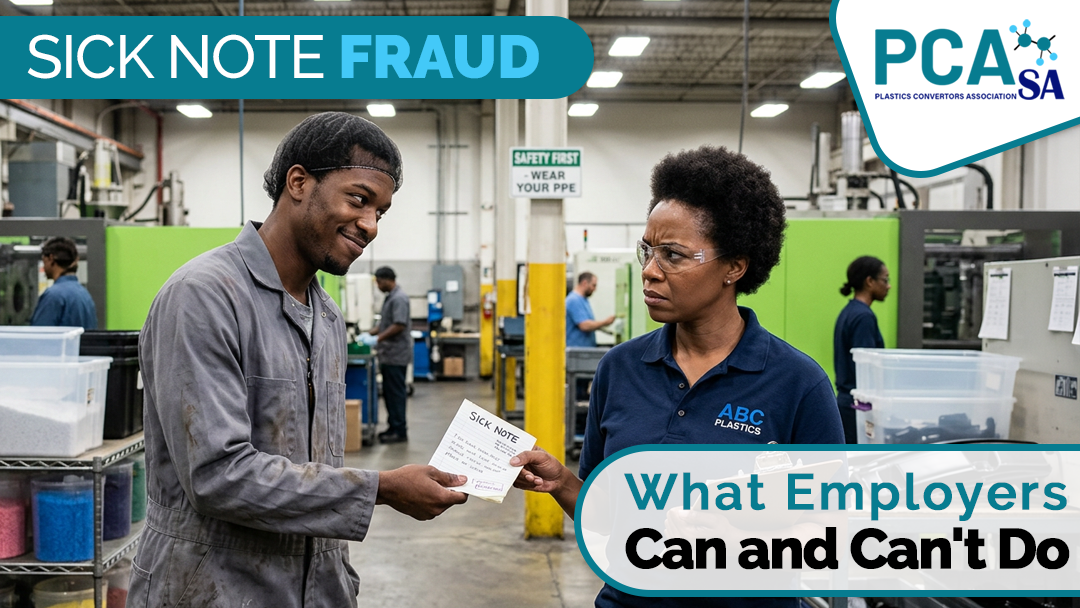
Sick Note Fraud: What Employers Can (and Can’t) Do
Employee absenteeism is an unavoidable reality in every workplace, but when sick leave is abused through fraudulent medical certificates, it becomes far more than a staffing inconvenience. It affects productivity, places additional pressure on colleagues, disrupts production schedules and increases operational costs.
For employers in South Africa’s plastics converting industry, where production deadlines, customer commitments and compliance obligations are critical, sick note fraud can have a significant impact on business performance.
Understanding Sick Note Fraud: What Employers Can (and Can’t) Do is therefore essential for every employer. Responding too aggressively can expose a business to unfair labour practice claims, while failing to act appropriately can encourage further abuse. Employers must strike the correct balance between protecting their business and respecting employees’ legal rights.
For businesses operating under the Plastics Industry Main Collective Agreement (PIMCA) and within the framework of the Metal and Engineering Industries Bargaining Council (MEIBC), following the correct legal process is not optional. It is the foundation of a defensible disciplinary process that protects both the employer and the integrity of the workplace.
What Is Sick Note Fraud?
Sick note fraud occurs when an employee deliberately submits a medical certificate that is false, misleading or fraudulently obtained in an attempt to justify an absence from work.
Examples may include:
- Forged medical certificates.
- Altered or falsified medical certificates.
- Certificates issued without a genuine consultation.
- Medical notes obtained from practitioners who never examined the employee.
- Backdated certificates intended to cover unauthorised absences.
- Certificates issued by practitioners who are not legally authorised to issue medical certificates.
In each of these situations, the employee is not simply taking sick leave. The employee may be engaging in dishonesty. Under South African labour law, dishonesty can strike at the heart of the employment relationship because it damages the trust between employer and employee.
That is why Sick Note Fraud: What Employers Can (and Can’t) Do is an important topic for every employer. While dishonesty may justify dismissal in serious cases, employers must still follow a fair and legally compliant process before taking disciplinary action.
Why Sick Note Fraud Is a Serious Workplace Issue
Many employers underestimate the true cost of fraudulent absenteeism. Even one fraudulent absence may create operational and financial consequences that extend far beyond the employee concerned.
A fraudulent sick day can result in:
- Lost production.
- Increased overtime costs.
- Missed customer deadlines.
- Reduced team morale.
- Additional administrative costs.
- Increased operational risk.
- Pressure on employees who must cover the absent person’s duties.
Over time, repeated abuse can create a workplace culture where honest employees feel disadvantaged while dishonest behaviour goes unchecked. This may weaken discipline, damage morale and make it more difficult for managers to enforce workplace rules consistently.
Employers who fail to address suspected fraud may also find it increasingly difficult to manage similar incidents in the future. However, acting without sufficient evidence can be equally damaging. The correct response requires a proper investigation, objective evidence and a fair disciplinary process.
Recognising the Warning Signs
Not every suspicious absence is fraudulent. Employees can become genuinely ill at inconvenient times, and employers should avoid making assumptions. However, certain patterns may justify a closer investigation.
Possible warning signs include:
- Frequent absences on Mondays or Fridays.
- Sick leave immediately before or after public holidays.
- Recurring absences around long weekends.
- Multiple certificates from different medical practitioners.
- Certificates containing visible alterations or inconsistent information.
- Identical wording appearing across several certificates.
- Certificates issued by practitioners located far from the employee’s home or workplace without a clear explanation.
- A repeated pattern of exhausting sick leave entitlement.
- Medical certificates that cannot be verified with the issuing practice.
A suspicious pattern is not proof of misconduct. It is simply a reason to gather further information. Employers should avoid accusing an employee before the facts have been established.
What Employers Can Do
South African labour legislation provides employers with lawful ways to investigate suspected sick note fraud. The employer’s aim should be to verify the authenticity of the certificate without violating the employee’s right to medical confidentiality.
Verify the Medical Certificate
Employers may contact the medical practitioner or practice named on the certificate to confirm whether:
- The practitioner issued the certificate.
- The employee attended a consultation.
- The consultation took place on the date reflected on the certificate.
- The certificate is authentic.
The employer should limit the enquiry to verification. It is generally not appropriate to ask for the employee’s diagnosis, treatment details or confidential medical records.
Confirm the Practitioner’s Registration
Employers may verify whether the practitioner is registered with the appropriate professional body, such as the Health Professions Council of South Africa (HPCSA).
A medical certificate must meet the requirements of the Basic Conditions of Employment Act (BCEA). If the person issuing the certificate is not legally authorised to diagnose and treat patients, the certificate may not satisfy the relevant legal requirements.
Conduct a Fair Investigation
Before disciplinary action is considered, the employer should gather and preserve all relevant evidence.
This may include:
- The original medical certificate or a clear copy.
- Attendance records.
- Previous absenteeism patterns.
- Statements from supervisors or managers.
- Confirmation from the issuing medical practice.
- Records of discussions held with the employee.
- Relevant workplace policies.
The investigation should be objective and fact-based. Employers should not begin the process with a predetermined outcome.
Ask the Employee for an Explanation
Before formal disciplinary action is taken, the employee should be given an opportunity to explain the circumstances surrounding the certificate.
There may be an innocent explanation for an apparent discrepancy. The employee may also provide information that assists the employer in verifying the certificate. Giving the employee a fair opportunity to respond strengthens the integrity of the investigation.
Hold a Formal Disciplinary Enquiry
If sufficient evidence exists to support an allegation of dishonesty, the employer may institute formal disciplinary proceedings.
The employee should receive:
- Written notice of the allegations.
- Reasonable time to prepare.
- An opportunity to state their case.
- An opportunity to present evidence.
- An opportunity to call witnesses where appropriate.
- A fair and impartial hearing.
The disciplinary process should comply with the employer’s disciplinary code, applicable collective agreements and the principles contained in Schedule 8 of the Labour Relations Act.
Consider Dismissal Where Appropriate
Sick note fraud can constitute serious dishonesty. In appropriate circumstances, dismissal may be a fair sanction. However, dismissal should never be automatic.
The employer should consider:
- The seriousness of the misconduct.
- The strength of the evidence.
- The employee’s disciplinary record.
- The employee’s length of service.
- Any mitigating or aggravating circumstances.
- Whether the trust relationship has been damaged.
- How similar cases have been handled in the workplace.
A sanction should be proportionate to the misconduct and supported by the facts of the case.
What Employers Cannot Do
Understanding Sick Note Fraud: What Employers Can (and Can’t) Do also requires employers to recognise the legal and procedural limits placed on them.
Many disciplinary cases fail not because the employee’s conduct was acceptable, but because the employer followed an unfair or inconsistent procedure.
Do Not Reject a Medical Certificate Without Grounds
An employer should not reject a certificate simply because it appears suspicious or because the employer does not trust the employee.
There must be reasonable grounds for questioning the certificate, followed by a proper investigation. Suspicion alone is not enough to establish misconduct.
Do Not Demand Confidential Medical Information
Employees have a right to privacy. Employers should not insist on access to:
- Medical files.
- Detailed diagnoses.
- Treatment records.
- Prescriptions.
- Private consultation notes.
The employer’s enquiry should generally be limited to confirming whether the consultation occurred and whether the certificate is genuine.
Do Not Assume Guilt
Even where an employee has a history of absenteeism, each incident must be assessed on its own facts.
A manager who enters the disciplinary process with a predetermined decision may compromise the fairness of the enquiry and expose the business to an adverse finding.
Do Not Skip the Disciplinary Process
Employers should not take immediate punitive action without following a fair process.
Employers should avoid:
- Dismissing an employee on the spot.
- Withholding pay without lawful grounds.
- Removing benefits as punishment.
- Publicly accusing the employee of fraud.
- Imposing informal penalties outside the disciplinary procedure.
- Pressuring the employee to resign.
Procedural fairness is just as important as having a valid reason for discipline.
Do Not Apply Policies Inconsistently
Consistency is an important principle in South African labour law. Employees accused of similar misconduct should generally be treated according to the same standards.
If one employee is disciplined for submitting a fraudulent certificate while another employee is ignored in similar circumstances, the employer may face claims of inconsistency or unfair treatment.
Building a Defensible Process
The most effective way to manage Sick Note Fraud: What Employers Can (and Can’t) Do is to establish the correct policies, procedures and documentation before an incident occurs.
A defensible process should include:
- A clear sick leave policy.
- A disciplinary code that identifies dishonesty as misconduct.
- Defined reporting and notification procedures.
- Guidelines explaining when medical certificates are required.
- Clear standards regarding who may issue a valid certificate.
- Consistent enforcement across the workforce.
- Accurate attendance and disciplinary records.
- Training for supervisors and managers.
Employees should be informed of these rules during induction and reminded of them through policy updates, toolbox talks and management communication.
When expectations are clearly communicated, employers are in a much stronger position to address misconduct fairly and consistently.
Developing a Strong Sick Leave Policy
A comprehensive sick leave policy should explain both the employee’s rights and responsibilities.
The policy should cover:
- How and when employees must report an absence.
- Who the employee must notify.
- When a medical certificate is required.
- The information a certificate must contain.
- Which practitioners may issue acceptable certificates.
- The employer’s right to verify authenticity.
- The consequences of submitting fraudulent documents.
- The disciplinary process that may follow.
Policies should be written clearly, made accessible to employees and applied consistently. A policy that exists only in a filing cabinet will offer limited protection if employees were never properly informed of it.
Prevention Is Better Than Discipline
Disciplinary action may sometimes be necessary, but prevention remains the most effective strategy.
Employers can reduce the risk of sick note fraud by:
- Maintaining accurate attendance records.
- Monitoring recurring absenteeism trends.
- Training supervisors to recognise suspicious patterns.
- Applying policies consistently.
- Communicating expectations clearly.
- Addressing workplace concerns before absenteeism becomes habitual.
- Creating channels through which employees can raise legitimate health or workplace concerns.
A proactive approach allows employers to identify patterns early and address concerns before they develop into serious disciplinary matters.
Why Specialist Advice Matters
Labour disputes are rarely as simple as they first appear. Even where the evidence seems strong, an employer’s case may be weakened by incomplete documentation, inconsistent treatment or procedural errors.
A seemingly straightforward matter can become complicated when:
- The medical practitioner refuses to provide confirmation.
- The certificate contains incomplete information.
- The employee disputes the employer’s evidence.
- The workplace policy is unclear.
- Similar cases were handled differently in the past.
- The disciplinary chairperson is not impartial.
- The sanction is disproportionate to the misconduct.
Obtaining specialist labour relations advice before making a final decision can prevent an avoidable dispute and help ensure that both the investigation and disciplinary process are legally defensible.
The PCASA Advantage
Managing Sick Note Fraud: What Employers Can (and Can’t) Do requires more than a general understanding of labour law. It requires practical experience within the plastics industry and a thorough understanding of the agreements and structures that apply to employers in the sector.
PCASA is an Employers’ Organisation dedicated exclusively to representing and supporting members in South Africa’s plastics industry.
PCASA members have access to experienced labour relations specialists and admitted attorneys who can assist with:
- Investigating suspected sick note fraud.
- Assessing questionable medical certificates.
- Preparing disciplinary notices and documentation.
- Advising managers on fair procedures.
- Preparing for disciplinary enquiries.
- Determining an appropriate sanction.
- Representing employers where permitted.
- Ensuring compliance with PIMCA and applicable labour legislation.
From the moment a suspicious certificate is submitted until the matter is concluded, PCASA works alongside employers to help ensure that every step is procedurally and substantively fair.
This support protects the business, strengthens the employer’s case and improves the likelihood that the decision will withstand scrutiny should the matter proceed to the MEIBC or another dispute resolution forum.
Protect Your Business with Expert Guidance
When it comes to Sick Note Fraud: What Employers Can (and Can’t) Do, knowledge is the employer’s first line of defence.
Acting too quickly can expose a business to costly legal disputes, while failing to act may encourage further abuse and undermine workplace discipline. The safest approach is to establish clear policies, investigate the facts, follow a fair process and obtain specialist advice before making a final decision.
PCASA assists plastics employers with sick note fraud, absenteeism, disciplinary hearings, labour relations, compliance and other workplace challenges.